

Keywords: P&L statement, financial statement, net income, revenue, expenses.
Written By: Sultan Coker Photo by: Creativity
Table of Contents:
- Introduction
- What is a Profit and Loss Statement?
- Why is a Profit and Loss Statement Important?
- Components of a Profit and Loss Statement
- How to Create a Profit and Loss Statement
- Example of a Profit and Loss Statement
- Conclusion
Introduction
A Profit and Loss (P&L) statement is a financial statement that provides a summary of a company’s revenues, expenses, gains, and losses over a specific period of time, usually a fiscal quarter or year. It is also known as an income statement or statement of operations. The P&L statement is one of the primary financial statements used by companies to measure their financial performance.
What is a Profit and Loss Statement?
A Profit and Loss statement is a financial document that provides a summary of a company’s revenues, expenses, gains, and losses over a specific period of time. The statement shows the company’s total revenues and the cost of goods sold (COGS), which is the cost of the products or services sold by the company. From these figures, the statement calculates the company’s gross profit, which is the difference between total revenues and COGS.
After calculating the gross profit, the P&L statement deducts all other expenses incurred by the company, such as salaries, rent, utilities, and taxes. The resulting figure is the company’s net income or net loss for the period. A positive net income indicates that the company has made a profit, while a negative net income indicates that the company has incurred a loss.
Why is a Profit and Loss Statement Important?
A Profit and Loss statement is an important financial statement for companies because it provides insight into the company’s financial health. It allows the company to see how much revenue it is generating, as well as the costs it is incurring to generate that revenue. This information can help the company make informed decisions about its operations, such as pricing, marketing, and expenses.
Investors and creditors also rely on P&L statements to evaluate a company’s financial performance. These stakeholders want to see that the company is generating enough revenue to cover its expenses and earn a profit. A well-prepared P&L statement can also help a company secure financing from lenders or attract investors. A profit and loss statement is one of several financial statements that is prepared by a bookkeeper/accountant in determining the financial health of a business. it is important to know that a profit and loss statement is an important part of bookkeeping for businesses.
Components of a Profit and Loss Statement
A Profit and Loss statement is typically divided into three sections: revenues, expenses, and net income. The revenues section includes all the income the company has earned over the period, including sales, interest, and other sources of revenue. The expenses section includes all the costs the company has incurred over the period, such as salaries, rent, utilities, and taxes. The net income section shows the company’s profit or loss for the period.
Here’s a breakdown of each section:
Revenues
The revenues section includes all the income the company has earned over the period. This includes sales revenue, interest income, and any other sources of revenue. The total revenue figure is calculated by adding up all the revenue sources.
Expenses
The expenses section includes all the costs the company has incurred over the period. This includes the cost of goods sold, salaries, rent, utilities, taxes, and any other expenses. The total expense figure is calculated by adding up all the expenses incurred.
Net Income
The net income section shows the company’s profit or loss for the period. It is calculated by subtracting the total expenses from the total revenue. If the resulting figure is positive, the company has made a profit. If the resulting figure is negative, the company has incurred a loss.
How to Create a Profit and Loss Statement
Creating a Profit and Loss statement requires gathering financial data from the company’s income and expense records. The statement can be created manually using a spreadsheet or accounting software.
Here are the steps to create a Profit and Loss statement:
- Gather financial data: Collect all the financial data from the company’s income and expense records for the period you want to create the statement for.
- Organize the data: Organize the financial data into revenue and expense categories. This will make it easier to create the statement.
- Calculate revenue: Add up all the revenue sources for the period.
- Calculate cost of goods sold (COGS): Calculate the cost of goods sold for the period. This includes the cost of the products or services sold by the company.
- Calculate gross profit: Subtract the cost of goods sold from the total revenue to calculate the gross profit.
- Calculate expenses: Add up all the expenses incurred by the company for the period.
- Calculate net income: Subtract the total expenses from the gross profit to calculate the net income.
- Format the statement: Format the statement to include all the revenue and expense categories and the calculated figures.
Example of a Profit and Loss Statement
Here is an example of a Profit and Loss statement for a fictional company, ABC Inc., for the fiscal year 2023:
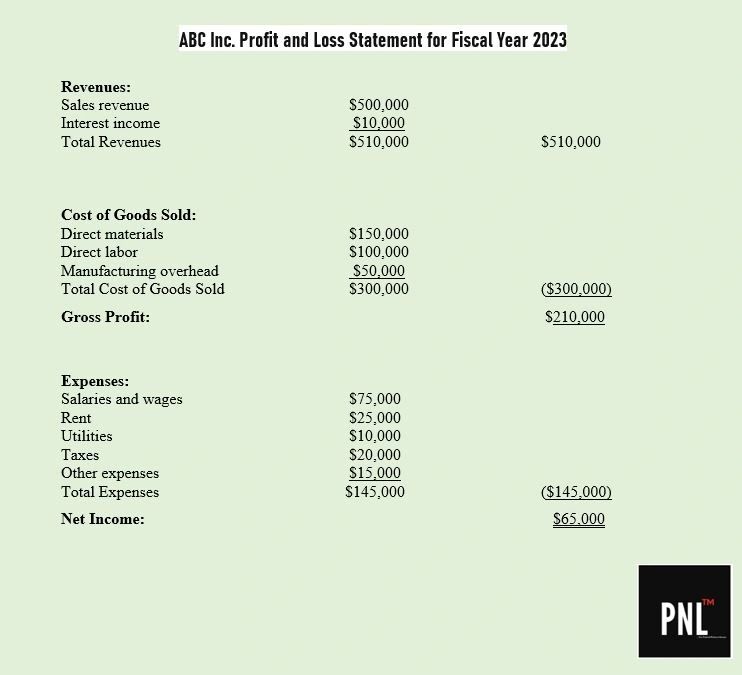
In this example, ABC Inc. earned $510,000 in revenue and incurred $300,000 in cost of goods sold. After deducting all other expenses of $145,000, the company’s net income for the fiscal year 2023 was $65,000.
Conclusion
A Profit and Loss statement is an important financial statement that shows a company’s revenues, expenses, gains, and losses over a specific period of time. It allows the company to see how much revenue it is generating and the costs it is incurring to generate that revenue. Investors and creditors also rely on P&L statements to evaluate a company’s financial performance. Creating a Profit and Loss statement involves gathering financial data, organizing it into revenue and expense categories, and calculating the revenue, expenses, and net income.
Check out our Homepage